Three Fewer Trucks at Nettorama
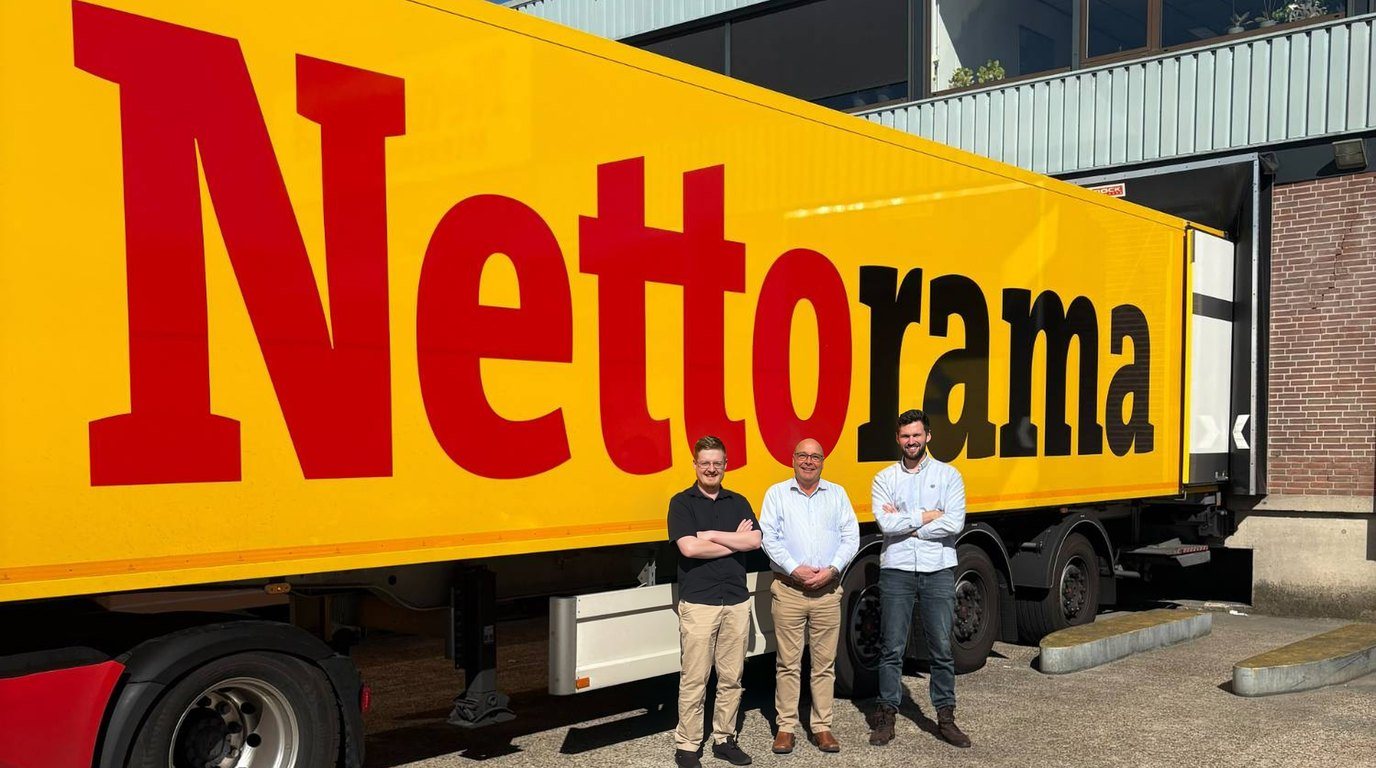
Say you run a supermarket chain. Fresh products come in every day, so you only know late what has to go to which store. When do you plan the trucks?
As late as possible. And then every route has to be right the first time.
That is how it goes at Nettorama. Every fresh run leaves from one fresh DC in Nijkerk, and they plan those runs with the TMS we build at DataFirst Logistics. This is what it brought:
Why is this hard?
Planning one trip is not hard. Say a truck has to visit 10 stores. In how many orders can it do that? \[10! = 3\,628\,800\]
A computer just tries them all. Now say 20 stores: \[20! \approx 2.4 \times 10^{18}\]
At a billion orders per second that takes 77 years. And that is still one truck, without any rules.
Now add the rules. There are eight, and they all apply at the same time:
The annoying part is that they interlock. If a truck reaches the first store later, it falls outside the window at the next one. Or it stands there together with another truck, and that is not allowed:
So how do you plan it?
Not by trying everything. You start with some plan and keep making small changes: move a store to another truck, swap two stores, turn a piece of a route around. If the plan gets cheaper, you keep the change. A change that breaks a rule is made so expensive that it loses.
Do that many thousands of times and you have routes that fit every rule, in seconds. The rules were entered once. After that you see per trip the hours, the kilometres and what you pay in truck toll.
And a truck does more than one trip a day, so the reloading is in the plan too:
“DataFirst Logistics came out as the best among all evaluated parties, and the daily improvement in fuel, driving time and planning reliability speaks for itself.”
What changed in practice
How long did that take?
Four working sessions. No long implementation project.
The longer version is on the DataFirst site: the article and the customer story.