A Short Note on the Doppler Effect
I was wandering around the forest when I thought about the following scenario:
Say an ambulance drives towards you, we know (or just looked up) what happens to the pitch of the sounds.
The sounds speeds up (or the frequency increases). Now what happens when an ambulance comes towards you faster than the speed of sound?
To answer this question let’s draw out the scenarios. Below, the red dot is the ambulance, the green square is you, and wavefront color encodes emission age very explicitly:
- cyan = OLDER emission
- orange = NEWER emission
Speeds are in units where the speed of sound is (c).
Each animation has synchronized audio. Browsers block autoplay with sound, so the videos start muted — tap the speaker overlay on any video to enable sound; it will restart from the beginning so the siren arrival lines up with the first wavefront reaching the observer. A yellow ring + “HEARING” label flashes on the observer when sound is currently arriving.
Standing still
The source stays put; wavefronts are nested circles spaced evenly in time. The siren reaches you delayed by (d/c); pitch unchanged.
Moving away at the speed of sound ((v = c))
The ambulance recedes as fast as the waves propagate along the line of motion. Audio arrives at half speed (pitch dropped an octave) because each emission travels an extra (c\,\Delta t) before reaching you.
Toward you at the speed of sound ((v = c))
Now the ambulance approaches at exactly (c). All wavefronts emitted while approaching arrive at the observer at the same instant. In the audio you hear silence, then a single compressed shock burst containing all of the buildup at once.
Toward you faster than sound ((v = 2c))
Before scrolling, stop and think for a second: the ambulance now moves toward you faster than its own sound. What do the wavefronts look like, and — more interestingly — what do you actually hear?
Got a guess? Reveal the animation and the synced audio below.
Past \(c\), the source outruns earlier wavefronts and the envelope forms a Mach cone. The siren turns off after a while, but already-emitted waves keep propagating. The audio mapping is \(t_e = d_0/c - t_{obs}\) on the pre-crossing branch, which is literally the source audio reversed in time. So you hear the siren played backwards, starting at the moment the shock front reaches you.
Colored arrivals: standing still vs (v = 2c)
Each vertical line is a wave arrival at the observer, colored by emission age (cyan = older, orange = newer).
The top strip in each panel is the emitted color order; the bottom vertical lines are what you observe in time.
Compare standing still (arrivals keep the same ordering as emission) with toward at (2c) (arrivals can reorder relative to emission index).
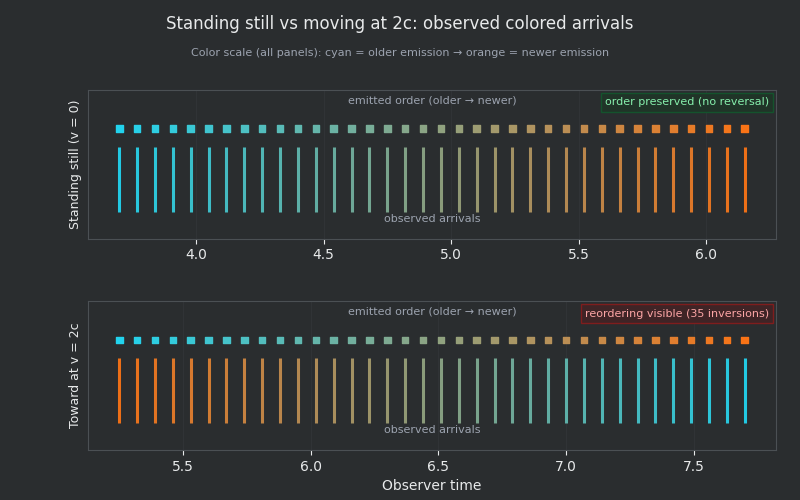
For the supersonic case, parts of the arrival sequence can run “backwards” relative to emission order, which is one way to think about why the perceived waveform can sound scrambled compared with what left the siren.